
Arrest Records in Montague County
Montague County arrests can be made by the Sheriff's Office, Bowie Police, Nocona Police, Saint Jo Police, the two county constables, or Texas DPS Highway Patrol. The agency that made or investigated the arrest normally keeps the report. The Montague County Detention Center creates a separate booking record when a person enters county custody. That split matters because jail staff may know the booking number and bond status but may not hold the officer's narrative.
An arrest record documents an allegation and a custody event. It is not a finding of guilt. Booking charges can be rejected, changed, enhanced, or replaced when a prosecutor reviews the facts. A filed Montague County case can then end in dismissal, acquittal, deferred adjudication, or conviction. For that reason, a sound search matches the arrest and booking details to the later court file instead of treating the first charge label as the final outcome.
Montague County Jail Bookings
The Montague County Detention Center at 111 South Grand Street is a 101-bed indirect-supervision jail. Official Sheriff text says 22 employees support jail and transport work across two shifts. The facility holds people in local custody before release or transfer, but the roster is not a historical list of every Montague County arrest. A person can leave the live list after release, and someone serving a state sentence may later be found through TDCJ instead.
The official Sheriff site links an Inmates in Custody interface as its current online channel. The live vendor interface has not exposed a stable, verified field manual, so use the controls shown at the time of search. A result may show a name, booking identifier, booking date, charge, bond, or custody status. Other details should be treated as available only if the current view displays them.
The Sheriff-linked Montague custody interface is the source for the roster view below.
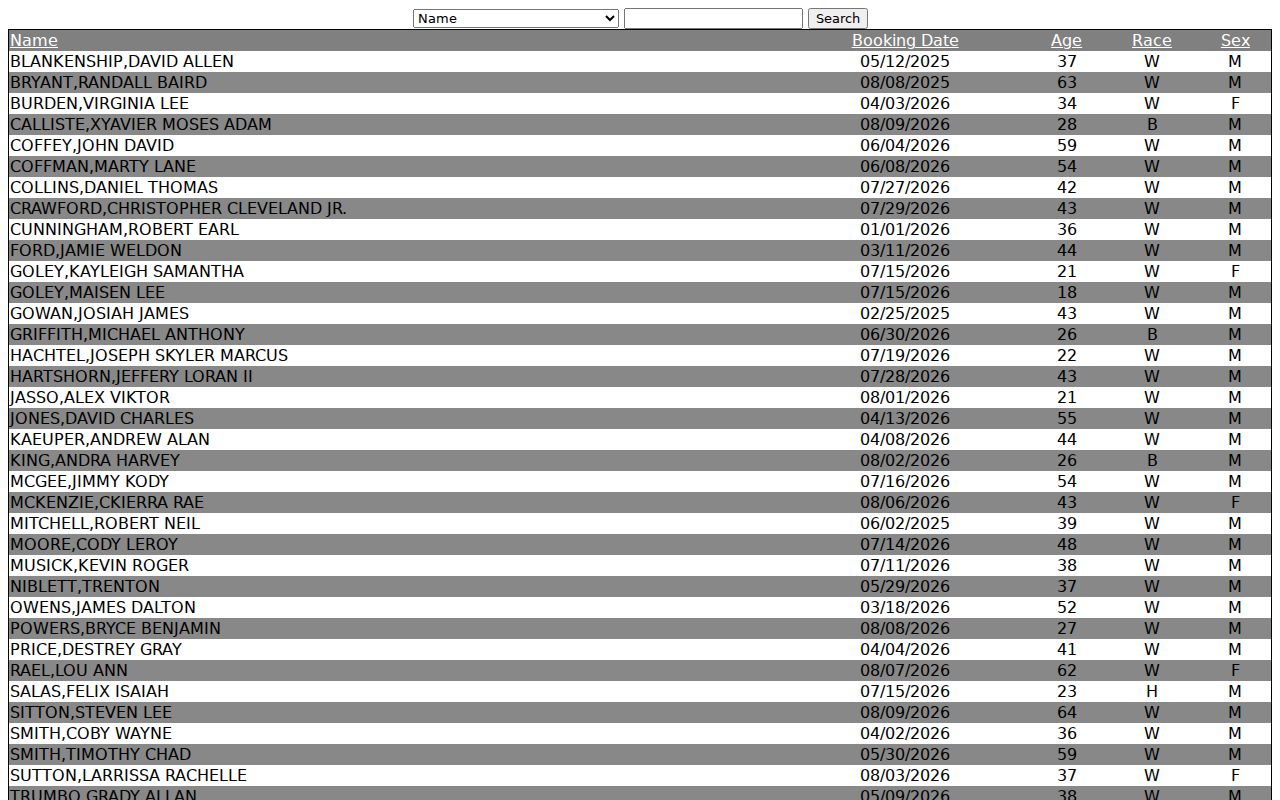
This roster is best used to confirm present custody and capture an identifier for a follow-up request, not to infer a conviction.
Montague County Arrest Lookups
No single channel provides a complete Montague County arrest history. Current custody, the arrest narrative, the filed court case, and the statewide public repository subset come from different custodians. Begin with the live jail route, then work outward. A name alone can produce a bad match, so carry forward a booking number, report number, case number, date, and arresting agency whenever they are lawfully available.
- Search the Sheriff-linked current-custody page. If it does not load, call the jail's 24-hour line at 940-894-2871.
- Identify the arresting agency and obtain the booking or incident identifier. Request an MCSO report from the Sheriff only when MCSO holds it.
- Use the correct city, constable, or DPS public-information channel if another agency created the arrest report.
- Check the Montague County Tyler court portal after charges are filed, or contact the issuing justice or municipal court for its matter.
- Use the Texas DPS public name search only for the statewide public conviction and deferred-adjudication subset, not as a recent arrest log.
- For a full review of your own Texas record, follow DPS personal-review instructions and FAST fingerprint submission through IdentoGO.
The paid Texas DPS Crime Records public site is narrower than a complete rap sheet. The proper way to see and challenge your own complete Texas Computerized Criminal History record is the fingerprint-based personal review procedure from the Texas Department of Public Safety.
Routing Montague County Arrest Reports
Who made the arrest determines who holds the report. Use the Montague County Sheriff's written request route for a deputy's report. A Bowie arrest report goes to Bowie Police, while Nocona and Saint Jo police records stay with those city departments. The county jail can still hold the booking entry even when a city officer made the arrest. Constable records route through the relevant county custodian, and a highway arrest report may require the Texas DPS public-information process.
| Arresting agency | Report route | Related Montague County record |
|---|---|---|
| Montague County Sheriff | Online, email, mail, or counter request to MCSO | County jail booking when the person is booked |
| Bowie, Nocona, or Saint Jo Police | The arresting city's police records channel | County jail booking and later county court file when applicable |
| Constable Precinct 1 or 2 | Contact the constable or county custodian | Issuing court and county jail records as applicable |
| Texas DPS Highway Patrol | DPS public-information process | County jail custody and Montague County court case when filed |
The report custodian follows the agency, not the road where the stop occurred. This point is especially useful in rural Montague County, where city officers, deputies, constables, and troopers may all bring people to the same detention center. Sending the request to the jail does not make the jail the author of each arrest narrative.
Arrest Records: What They Contain
A Montague County arrest episode can create several records at once. The officer's file may contain the service or report number, date, time, place, legal authority, alleged offenses, and probable-cause narrative. The jail file records intake, identity checks, property, screening, custody classification, charge entry, bond, and release. A magistrate creates a separate record of warnings, counsel information, probable-cause review, and bail decisions.
| Booking Number | Connects the person to one Montague County jail intake event. |
|---|---|
| Booking Date & Time | Shows when jail intake occurred, which can differ from the arrest time. |
| Arresting Agency | Identifies the likely custodian of the incident or arrest narrative. |
| Charges | Lists allegations received at booking; they may change after prosecutor review. |
| Bond | May show the type, amount, conditions, issuing court, or warrant number if public. |
| Booking Photograph | May be part of the booking file if released, but no image is proof of guilt. |
| Release Status | May identify release date or method; absence from a live roster does not explain the outcome. |
Protected medical and jail-classification data should not be expected in a public response. The same is true for juvenile information, protected victim details, and confidential identifiers. Ask for an existing record by date, location, case number, and known subject. Do not ask the Sheriff to answer open-ended questions or create a new summary.
First 48 Hours After Arrest
Booking generally includes identity verification, a property inventory, fingerprints and a photograph, medical and mental-health screening, security classification, charge or warrant entry, and cell placement. Fingerprints for a reportable offense can also create an arrest transaction in the Texas DPS Computerized Criminal History system. That state transaction and the Montague County jail entry serve different purposes and may update on different schedules.
Texas magistrate duties call for a prompt appearance, generally within 48 hours after arrest under Code of Criminal Procedure Article 15.17. The magistrate gives required warnings, addresses counsel, considers probable cause, and handles bail within the governing rules. Justice of the Peace courts can perform that role even though a later felony prosecution belongs in District Court.
The official Justice Court Precinct 2 page shows one Montague County magistrate and court contact.
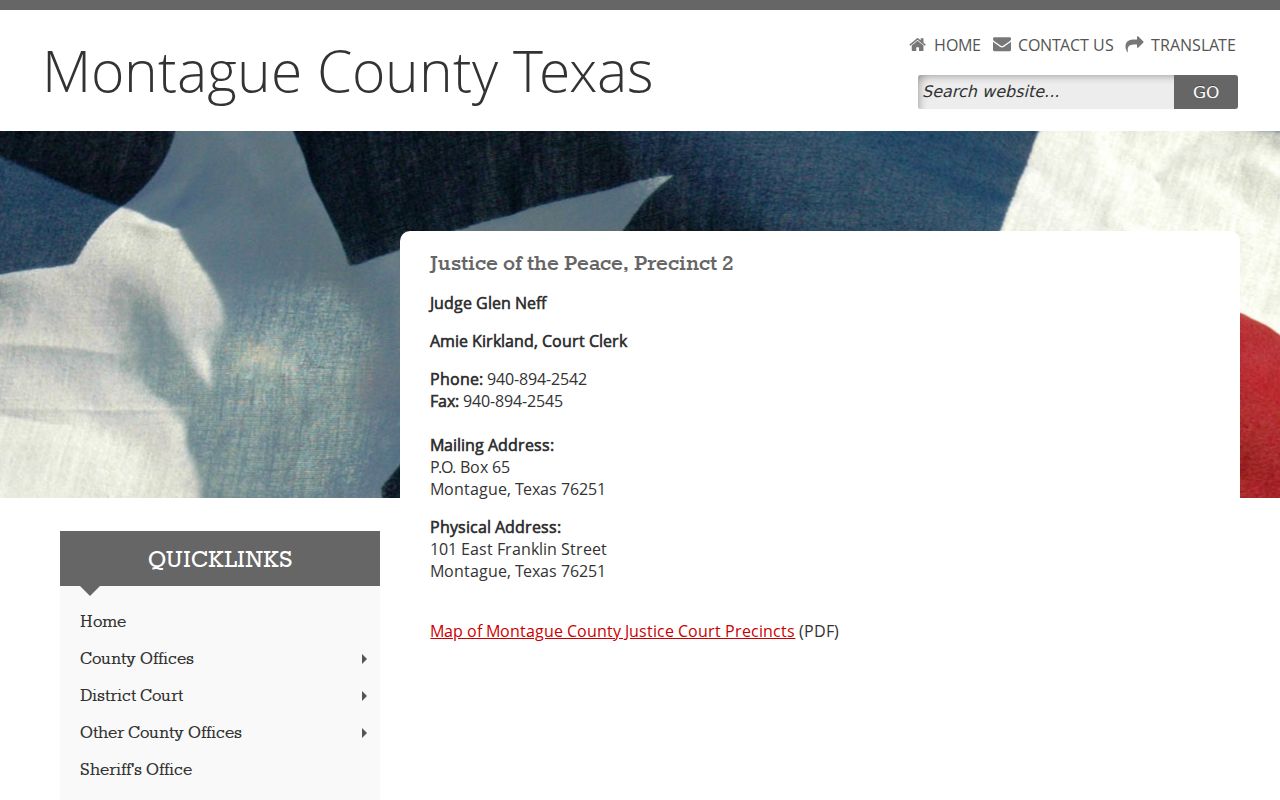
This court role helps explain why the first bond or warning record may come from a justice court before a prosecutor files the main case.
Note: A booking charge is preliminary, and the later charging paper is the better source for what the prosecutor chose to pursue.
Recent Montague County Bookings
The Sheriff-linked current-custody page is the main web route for a recent Montague County booking. Its availability can vary. When it fails, call 940-894-2871 and ask about current custody. A useful inquiry includes the person's full name and a reasonable date range, but readers should avoid publishing private identifiers or treating a name-only response as a sure match.
Live custody lists roll forward. A person who bonded out, was released, or transferred may no longer appear. Someone who was arrested by a Bowie officer can appear in the Montague County jail list even though Bowie Police holds the report. A sentenced person who moves to state custody should be searched through the TDCJ Online Inmate Search, which accepts a name, TDCJ number, or SID number and can show state location and sentence-related fields.
Do not use an old screenshot as proof of current custody, bond, or charge status. Call the jail for a live Montague County custody check and use the clerk's signed court record for the outcome. A roster answers where the person is now, if listed. It does not explain why a charge changed or how a case ended.
Montague Sheriff Record Requests
The Sheriff's Records Department is the fallback for an MCSO incident report, arrest narrative, booking material, dash-camera recording, body-camera recording, or other releasable Sheriff-created record. Requests must be in writing. The MCSO online request form asks for requester contact details, the information sought, a case number if known, incident location, date, involved people, and delivery choice. Requests may also go by email to AAnderson@MontagueSheriff.com, by mail to P.O. Box 127, or over the counter.
Body-camera requests need the date and approximate time, the specific location, and at least one known subject under Texas Occupations Code Section 1701.661. MCSO lists $10 per responsive recording plus $1 per full minute, for an $11 minimum. Standard paper is $0.10 per page or side. The office can give an estimate when expected charges exceed $40, and the requester can accept, narrow, or withdraw the request.
Montague County Sheriff's Office
111 S. Grand Street
Montague, TX 76251
940-894-2491
Jail and 24-hour line: 940-894-2871
The Sheriff may withhold protected material or seek a Texas Attorney General ruling. The office says it does not have to perform legal research, create new information, answer questions, or honor a continuing request. Describe an existing Montague County arrest record as closely as possible.
Arrest Records vs Conviction Records
Montague County arrest and conviction records come from different events. The arresting agency and jail document the allegation and custody. A court documents the filed charge and its result. DPS can receive fingerprint-linked arrest and disposition reports, but the public DPS name product is limited by Texas law mainly to public convictions and deferred adjudications. It is not a full public arrest timeline.
| Arrest record | Conviction record |
|---|---|
| Created by the arresting agency and jail | Created by the court after a judgment of guilt |
| Shows an allegation, arrest, or booking event | Shows the charge and final finding recorded in the judgment |
| Held with the agency, jail, and possibly DPS | Held by the proper Montague County clerk and reported to DPS |
| May be followed by release, no filing, dismissal, acquittal, or conviction | May be followed by sentence, appeal, or later lawful restriction |
The case file is the best source for what the prosecutor filed and how the court ruled. Search the Montague County court case records when a booking needs an outcome. Match by case number, date, court, and public identifiers rather than a name alone.
Note: An arrest is not proof of guilt, and a Montague County booking may end without a conviction or even a filed charge.
Dismissed Montague County Arrests
A dismissal does not automatically erase the Montague County booking episode. The jail, arresting agency, clerk, prosecutor, and DPS may each hold part of the record. Texas expunction under Code of Criminal Procedure Chapter 55A can require qualifying agencies to destroy or return eligible records, but the full statutory test must be met. A dismissal alone does not prove eligibility. Other charges from the same arrest, limitations periods, waiting rules, and the final disposition can matter.
An order of nondisclosure is different. It restricts public dissemination of eligible criminal-history information but does not destroy every record or block all authorized government access. A person checking their own history after relief should allow time for processing, review the Montague County portal, and use DPS personal review to inspect the state repository record. If an official entry remains, the maintaining agency may need a certified order and a correction request.
Use the signed dismissal, judgment, expunction order, or nondisclosure order rather than a stale booking page. Those documents identify what the court actually did and give each Montague County custodian a basis to review its own record.