
Montague County Sex Offender Checks
The Texas Department of Public Safety Public Sex Offender Registry is the main public lookup for Montague County. It combines name searches with geographic tools, then displays public information supplied through Texas registration processes. Start there when checking a specific name, an address, a city, a ZIP code, or Montague County as a whole.
The other official channels serve distinct needs. The Montague County Sheriff can route questions about local registration duties or a listed reporting agency. DPS can address the state system. The National Sex Offender Public Website, maintained by the U.S. Department of Justice, adds participating jurisdictions when a person or address may connect to another state. For a historical charge, disposition, or sentence, the registry should be compared with the court file rather than treated as the full criminal case.
Montague County Name and Map Searches
Name and place searches answer different questions. A name search works best when the spelling and identity are known. Because a public profile may include aliases, results should be compared with the photograph, physical details, date information shown by law, reporting agency, and offense information. Similar names alone are not a sound match.
An address search examines a location and radius, while county, city, and ZIP controls narrow a broader Montague County sex offender lookup. Map and list views present the same task in different forms. The map helps place results around a location; the list makes it easier to compare profile entries. Location data can change, so the address status and update fields deserve as much attention as the pin itself.
Texas Public Sex Offender Registry Searches
The DPS search has terms and warnings that should be read before the first query. The official interface shown below is the source of the Montague County registry search controls. It provides a direct route to public state data rather than a copied list.
- Open the DPS registry and review its conditions of use and public-safety notice.
- Choose a name search or a geographic search by address, city, county, ZIP code, or radius.
- Select Montague County when appropriate, then compare the map or list results with more than one identifier.
- Open a likely profile, read the reporting agency and update fields, and confirm important facts with that agency.
| Field or control | Type | Required | How it helps |
|---|---|---|---|
| Last name / first name | Text | Varies by mode | Finds names; profiles may also list aliases. |
| Address | Text | Geographic mode | Accepts street, city, and ZIP formatting through the live geocoder. |
| City / county | Text or dropdown | Optional | Narrows results; choose Montague for a county view. |
| ZIP code / radius | Text and dropdown | Optional | Defines an area around a place; current distance choices appear in the live portal. |
| Search / reset | Buttons | No | Runs or clears the current query. |
| Map / list | View controls | No | Changes how geographic results are presented. |
The DPS registry home shows how Texas begins a public search.
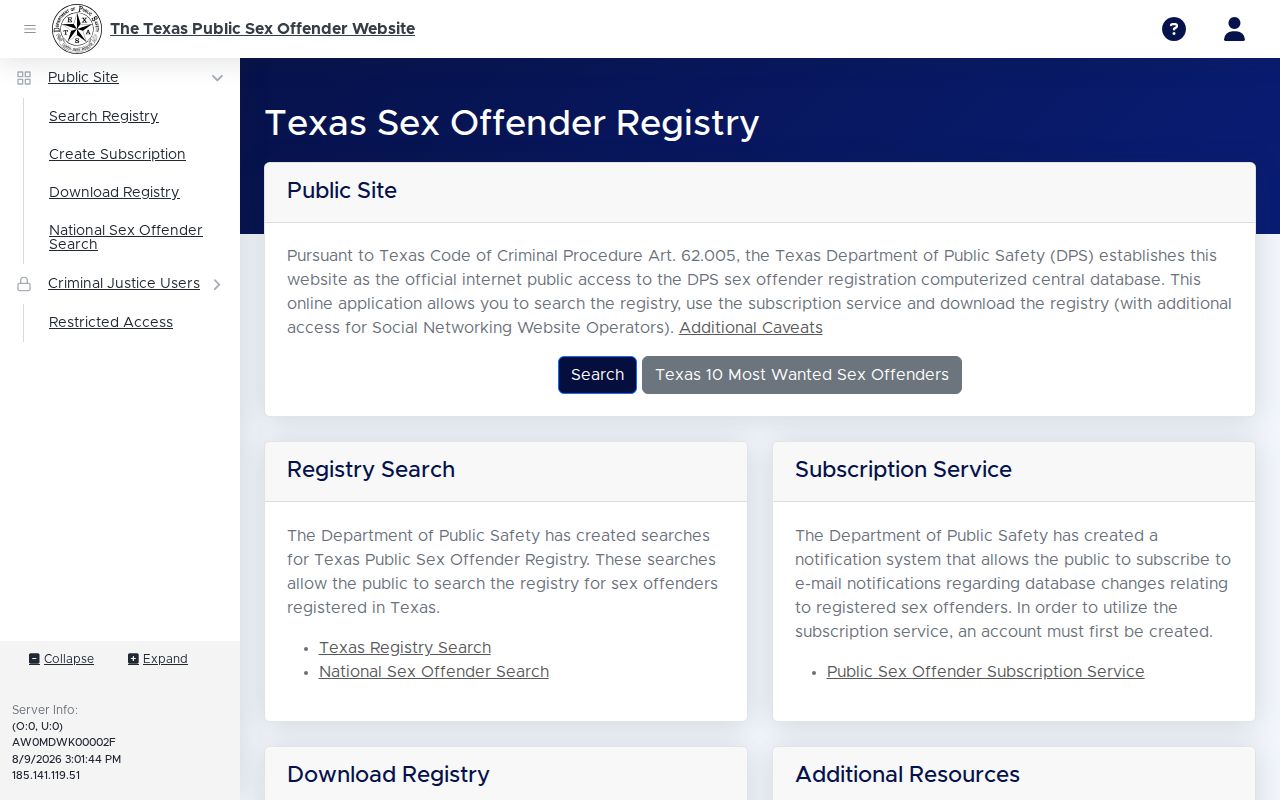
This screen is the correct starting point for state registry terms, name fields, and geographic search choices.
Montague County Registry Across State Lines
Montague County sits on the Texas side of the Red River, so a search tied to travel, a former address, or another state may be too narrow if it stops at DPS. NSOPW searches participating state, territorial, and tribal public registries through one federal interface. It is the practical second layer when a name or address may cross the Oklahoma line.
The U.S. Department of Justice national search shows the cross-jurisdiction starting screen used for that broader check.
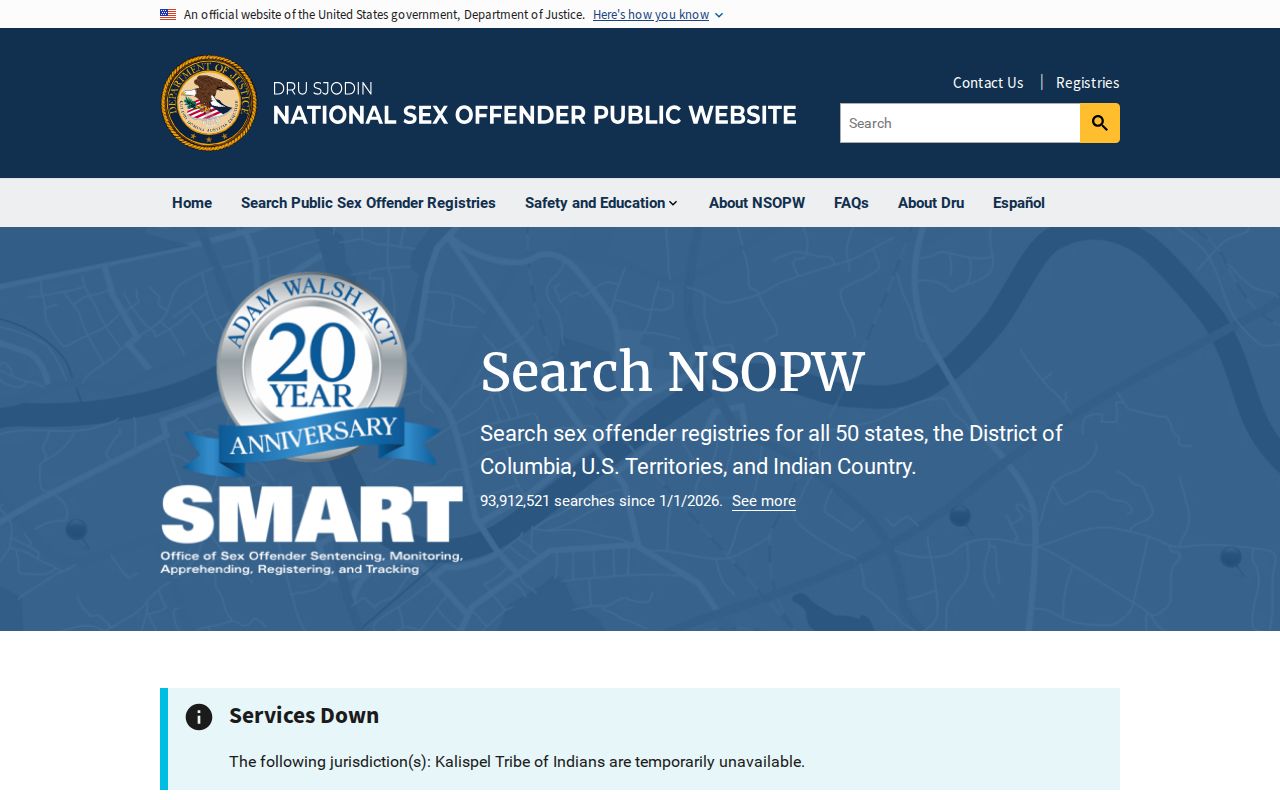
National coverage is a supplement, not a replacement for reading the DPS profile and contacting the listed registering agency.
Registry Profiles: What They Show
A public profile is an identity and registration record, not a full Montague County court file. Fields appear as Texas law authorizes them, and not every profile will display every possible item. Read the entries together. A photograph or shared name without the rest of the profile can point to the wrong person.
| Name and aliases | Registration name plus aliases included in the public record. |
|---|---|
| Photo and description | Current photograph, sex, race, height, weight, hair, eyes, and scars, marks, or tattoos when public. |
| Address information | Registered address and address status, with school or work information when public. |
| Offense information | Offense description or statute, conviction date, court or jurisdiction, and authorized victim category data. |
| Registration duty | Registration start and end dates or a lifetime indicator, plus risk level when Texas data supplies one. |
| Status and updates | Compliance status, reporting agency, verification dates, and update dates. |
| Other identifiers | Vehicle details and other public identifiers when they are part of the displayed record. |
The official DPS results interface demonstrates how results move from a list or map toward a full public profile.
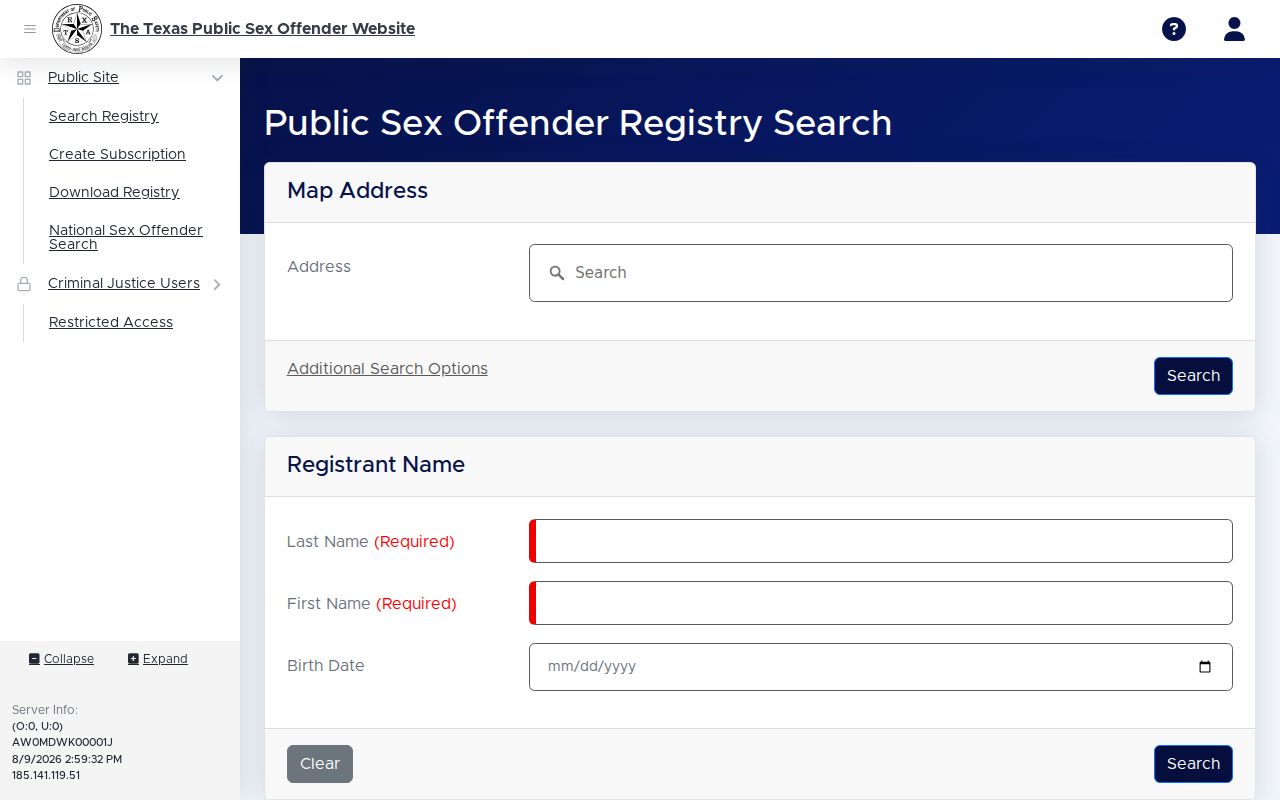
Use that result view to confirm the right entry before relying on any detail from the profile.
Montague County Sheriff Registration Questions
The Montague County Sheriff is the local contact for county law-enforcement questions and registration duties. The office is at 111 S. Grand Street, Montague, Texas 76251, with mail directed to P.O. Box 127. The county lists the nonemergency and jail line as 940-894-2871 and administration as 940-894-2491. Call first for the correct appointment or registration location rather than assuming a walk-in process.
The Sheriff's official site describes the office's countywide role, while the Montague County directory supplies the county office route. These local pages are useful when a DPS profile points back to Montague County for confirmation.
The Sheriff and DPS do not serve the same function. DPS publishes the statewide search and holds the public registry system. The local registering law-enforcement agency deals with local reporting and suspected noncompliance. If a profile names another agency, contact that reporting agency for a current confirmation. Emergencies should go to 911.
Registration Levels and Duties in Texas
Texas duration is offense-based. It should not be converted into a guessed three-tier chart, and a verification schedule should not be inferred from a label. Code of Criminal Procedure Chapter 62 ties the duty to the reportable conviction or adjudication, the person’s age, repeat status, and defined statutory rules. The profile’s risk field, when one appears, is not a safe shortcut for deciding duration.
| Texas framework | Duration | What to verify |
|---|---|---|
| Qualifying lifetime duties | Lifetime registration applies to many offenses covered by Chapter 62. | Match the reportable offense and statutory definition to Section 62.101. |
| Other adult duties | Often the later of ten years after release from confinement, parole, or community supervision, or the end of the court-ordered period. | Check the precise offense, dates, repeat status, and current profile. |
| Juvenile and special provisions | Different Chapter 62 rules can apply, including provisions for juvenile cases and early termination. | Review Sections 62.251 through 62.408 and the controlling order. |
For a specific Montague County registry duty, verify the offense under Texas Code of Criminal Procedure Chapter 62 and confirm the current record with the registering agency. The statute, the judgment, and the agency record control, not a generic federal tier description.
Missing Montague County Registry Results
No result is not the same as proof of no sexual-offense history. Publication rules, the date a record reached the system, out-of-state reporting, spelling, aliases, identity matching, and the statutory scope of registration can all affect what appears. Try both name and geographic modes, vary only facts you can verify, and use NSOPW when another jurisdiction may be involved.
If the goal is to understand an old prosecution rather than current registration status, use the Montague County court case lookup for the filed charge, case events, judgment, and disposition. A registry profile and a clerk’s case file answer different questions, and neither should be forced to stand in for the other.
Montague County Registry Dates and Status
Dates help a reader judge what the profile claims at a particular point in time. Look for verification and update dates, the registration start or end field, any lifetime indicator, address status, compliance status, and reporting agency. Those fields should be read together. One recent date does not guarantee that every part of a Montague County profile changed that day.
When a fact matters to immediate safety planning, contact the agency shown on the profile. The state registry warns that information can change and should be checked with the registering agency. Do not rely on an old screenshot, a copied post, or a map pin detached from the full profile.
Reporting Montague County Registry Noncompliance
Suspected noncompliance should be reported, not investigated by a member of the public. Preserve the public profile link and note the fact that appears inconsistent. Then contact the local registering law-enforcement agency named on the record or DPS. For a Montague County registration question, the Sheriff can route the report through its nonemergency channels.
Do not confront a listed person, visit an address to test the information, or publish accusations. Registry status can involve facts that are not visible to the public, and officers can compare the report with the official registration file. Call 911 only when there is an immediate emergency.
Using Registry Information Lawfully
The Texas registry exists for community awareness and safety planning. A lawful Montague County sex offender lookup can help a family understand a public entry, compare a location, or decide which agency to call. It does not authorize punishment, confrontation, exclusion, or a false claim about someone’s present conduct.
Use the registry lawfully: Using registry data to threaten, harass, intimidate, or commit another offense against a registrant or household is prohibited and can be a crime under Texas Code of Criminal Procedure Chapter 62 and the DPS portal warning.
Registry information also must not be used for vigilantism or unlawful discrimination. Verify all significant details with the office that maintains them. That final check matters because an address, status, or reporting agency may change after a saved result was created.