
Criminal Court Cases in Montague County
Montague County does not place every criminal case in one court. The 97th Judicial District Court hears felony cases, and the Montague County District Clerk keeps those files. Class A and Class B misdemeanors generally proceed in the constitutional County Court, with its records held by the County Clerk. Fine-only state-law charges and local ordinance cases can remain with a justice court or a Bowie, Nocona, or Saint Jo municipal court. The court named on the citation, bond paper, complaint, or cause record is the best routing clue.
The clerk preserves the filed case rather than the officer's arrest narrative. A Montague County criminal court file can contain the charging paper, settings, motions, orders, plea, judgment, sentence, and financial ledger. The Sheriff may hold the linked arrest report and booking record, but those are separate records. Readers tracing the event from custody into court can compare the filed case with the county's arrest search channels without assuming that the booking charge stayed the same.
The official 97th District Court site shows the court's regional identity.
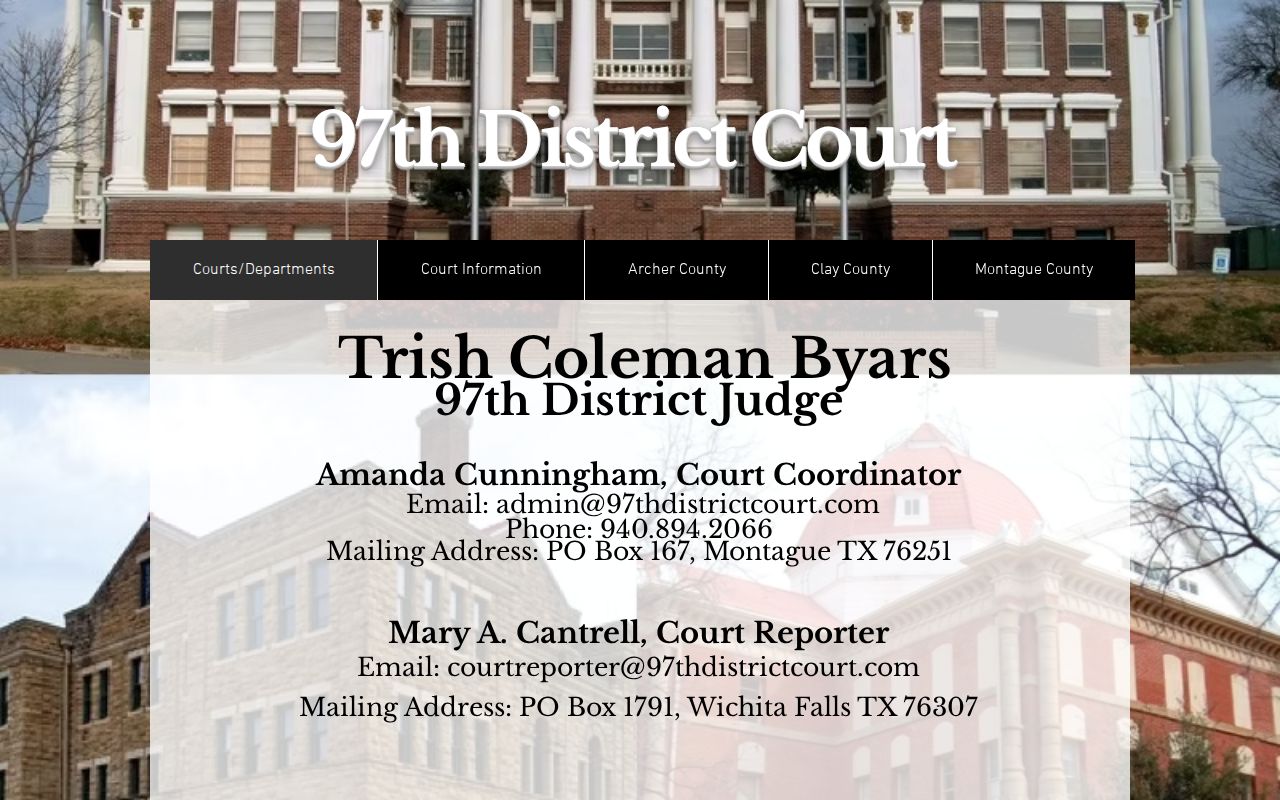
That three-county court structure makes the Montague County name and cause number important when identifying the right district file.
Montague County Court Map
The two main Montague County criminal clerks work from different buildings. The District Clerk is at 101 East Franklin Street in Montague and handles felony case files. The County Clerk is at the Courthouse Annex, 11339 State Highway 59 North, and handles the principal county misdemeanor files. Its public hours are Monday through Friday, 8:00 a.m. to noon and 1:00 to 4:45 p.m. The noon closure can affect a walk-in visit.
Justice courts remain separate custodians. Justice Court Precinct 1 and Justice Court Precinct 2 handle fine-only cases and perform magistrate and warrant functions within their authority. Precinct 2 is listed at 101 East Franklin, 940-894-2542. A searcher should contact the issuing court when a JP or municipal matter does not appear with a Montague County felony or misdemeanor result.
The official Montague County Clerk page identifies the misdemeanor record office and its online services.
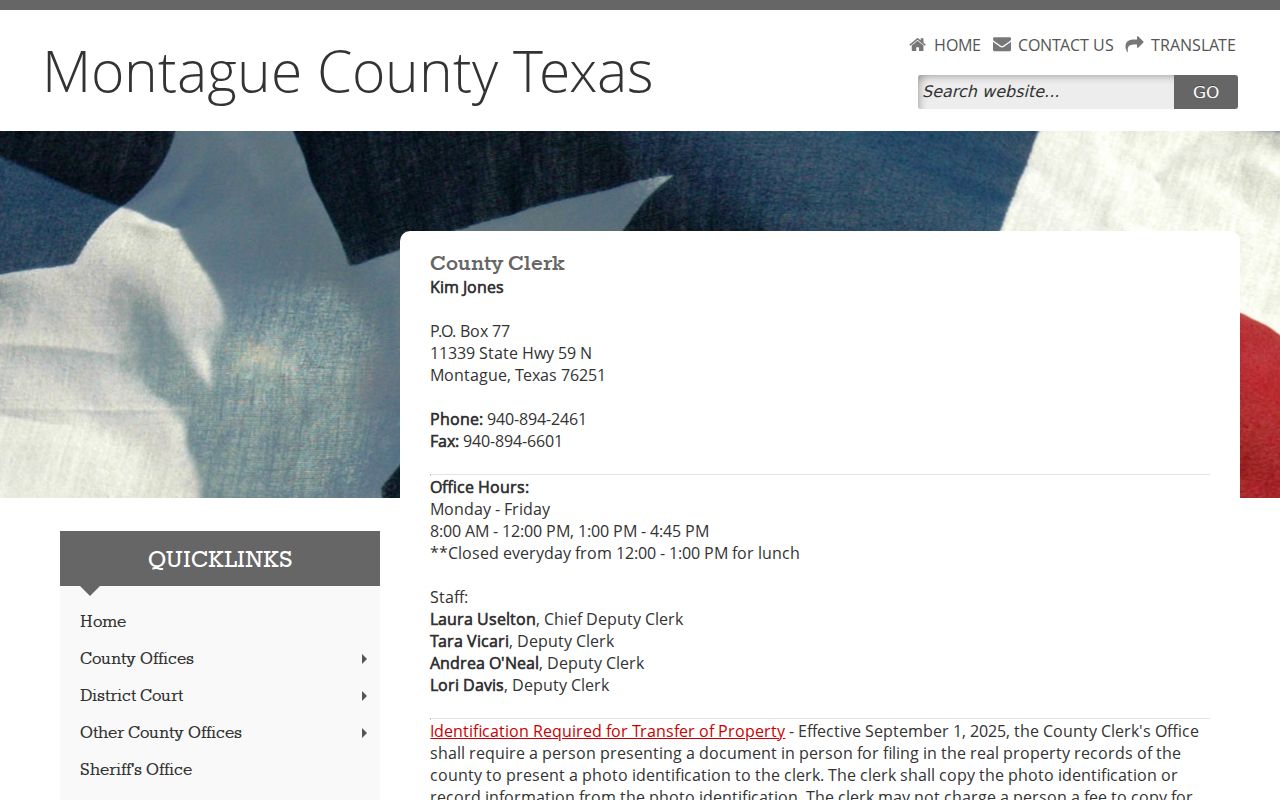
This separate clerk channel is why a district-only search can miss a Montague County misdemeanor case.
Montague County Case Record Searches
The Montague County Tyler Public Portal is the first online channel for local judicial records. Its controls are dynamic, so field labels and filters can change. The county confirms that its records are online, but it does not publish a fixed field manual. Search by a person's name or a known case or cause number where the live interface allows, separate criminal results from civil matters, then inspect the summary before ordering a document.
- Open the Tyler portal from the Montague County District Clerk page and select the relevant public search.
- Enter a party name or the exact case or cause number shown on a court paper.
- Use only the live filters the portal presents, then confirm the court, case type, and filing date.
- Read the docket and disposition, but locate the signed order or judgment before treating an entry as final.
- Request a plain or certified copy from the proper Montague County clerk when the needed document is absent.
| Search item | Entry type | Status | Use |
|---|---|---|---|
| Person or party name | Text | Interface-dependent | Find possible Montague County case matches. |
| Case or cause number | Text | Use when known | Targets one file and avoids a paid name search. |
| Case type | Filter | Interface-dependent | Separates criminal matters from other records. |
| Filing details | Filter or result field | Interface-dependent | Helps distinguish people with similar names. |
When two Montague County results share a similar name, compare the court, cause number, filing date, and public case details before ordering anything. The portal summary can narrow the choice, but the clerk's copy supplies the filed record.
Older Montague Court Cases
An empty portal result does not prove that no Montague County case exists. Older paper files, spelling differences, an unexpected court level, or a sealed record can all affect what appears. For a district matter, use the District Clerk record request form. It asks for the case or cause number, party name, document title, filing date when known, copy format, contact details, and payment information.
The completed form may be emailed to mcdc@co.montague.tx.us, faxed to 940-894-2077, mailed to P.O. Box 155, Montague, Texas 76251, or delivered to 101 East Franklin. The clerk says to allow up to ten business days. If no cause number is supplied, clerk research costs $5 per name in advance. Copies will not be sent to a third party, so the requester must give a usable personal delivery address or email.
The official Montague County District Clerk page links the request and online case channels.
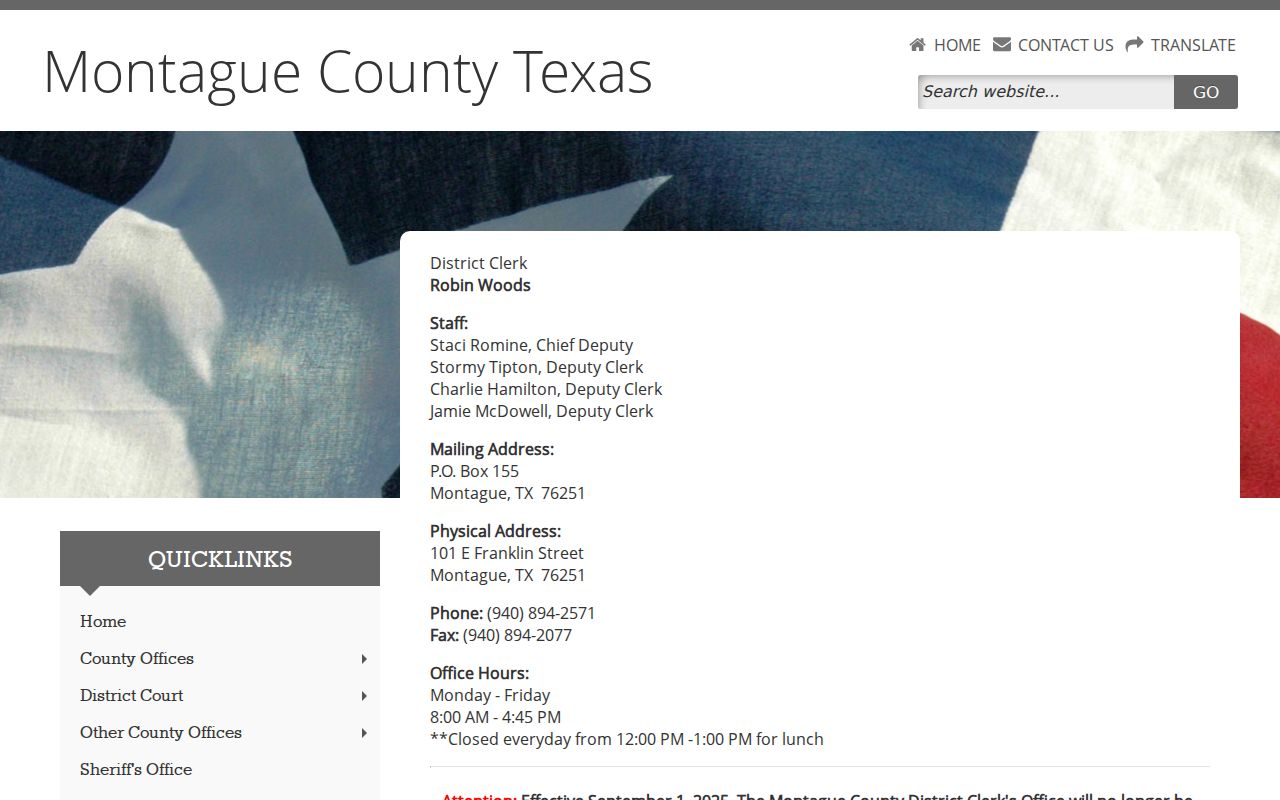
The office's direct form is the sound fallback when a Montague County felony document is not visible in the portal.
Note: A known cause number saves the $5 name-search fee and gives the clerk a more exact route to the requested case.
What a Criminal Case File Contains
A Montague County case file is organized around a prosecution, not a lifetime history. The most useful fields tie one cause number to one court, set of charges, event trail, and outcome. Public online views may omit a document image or redact a protected identifier. The file may still show enough docket detail to identify the order that should be requested from the clerk.
| Case Number & Court | Identifies the Montague County cause and the court that owns the file. |
|---|---|
| Charging Document | Shows the complaint, information, or indictment filed in court, which may differ from an arrest allegation. |
| Docket Entries | Lists filings and events in date order, including motions, settings, orders, and warrant or capias events when public. |
| Hearing Dates | Shows scheduled arraignment, pretrial, plea, trial, or sentencing events when entered. |
| Disposition & Judgment | States the result of each charge; the signed judgment is stronger than a short status label. |
| Sentence & Costs | Records the court's imposed sentence, community supervision, fines, costs, payments, or balance when public. |
Attorney information, bond events, offense statutes, and filed-document dates may also appear. Social Security numbers, full account data, protected victim facts, juvenile information, and sealed documents should be absent or redacted. If a result lists several counts, read the disposition of each count rather than treating one status as the outcome of the whole Montague County case.
Montague re:SearchTX Court Orders
Montague County uses two online systems for different tasks. Tyler is the county public case portal. re:SearchTX is the statewide electronic filing environment that the District Clerk directs attorneys and parties to use for certain electronically filed orders. The Texas Judicial Council reported that the broad re:SearchTX collection excludes criminal case records, so it should not be described as a complete statewide criminal trial-case search.
The distinction became more visible on September 1, 2025, when the Montague County District Clerk announced full re:SearchTX integration for certain orders and ended the need to send some 306A letters or orders. A party seeking such an order can check that environment. A member of the public beginning a Montague County criminal case search should still start with Tyler and the correct clerk. Access to a document can depend on the court, the user's role, and available permissions.
The official re:SearchTX interface illustrates this separate electronic order channel.
Treating Tyler and re:SearchTX as distinct tools prevents a false conclusion when one system does not show a criminal file.
Criminal Case Stages in Montague County
A Montague County prosecution starts after an arrest or complaint reaches a prosecutor. A felony can proceed to a grand jury and the 97th District Court, while a Class A or B misdemeanor normally moves through the County Court. The formal filed charge may differ from the charge shown at booking. After filing, the case can include arraignment, discovery, bond work, pretrial motions, negotiations, a plea or trial, judgment, sentence, and a possible appeal.
Case flow: Charges Filed › Arraignment › Pretrial › Plea or Trial › Disposition › Sentencing
Not every Montague County case reaches every stage. A prosecutor may reject a charge, a grand jury may return a no-bill, a count may be dismissed, or the defendant may enter a plea. The docket records events, but an upcoming setting is not a result. Likewise, an indictment is an accusation, not a judgment of guilt.
Reading Montague County Docket Events
Short docket labels need context. An arraignment is the court event where the accusation is addressed and a plea may be entered. A capias is a court writ directing an arrest. A disposition is the outcome of a charge, such as conviction, dismissal, acquittal, or deferred adjudication. Deferred adjudication places a person on community supervision without an immediate finding of guilt, and later record access depends on the actual result and Texas law.
- Indictment
- A grand jury's formal felony accusation, also called a true bill.
- No-bill
- A grand jury decision not to return an indictment on the presented matter.
- Docket
- The dated trail of filings and events, or a court's scheduled case list.
- Judgment
- The signed court record of the disposition and sentence, when a sentence applies.
A December 2025 report from the district attorney described presented matters, indictments, no-bills, and indictments sealed pending arrest. Those terms mark different stages. A sealed indictment awaiting arrest will not function like an open Montague County docket, while a no-bill is not the same as a dismissed filed case. Read the document tied to the event.
The official Justice Court Precinct 1 page is one local route for court-specific fine-only matters.
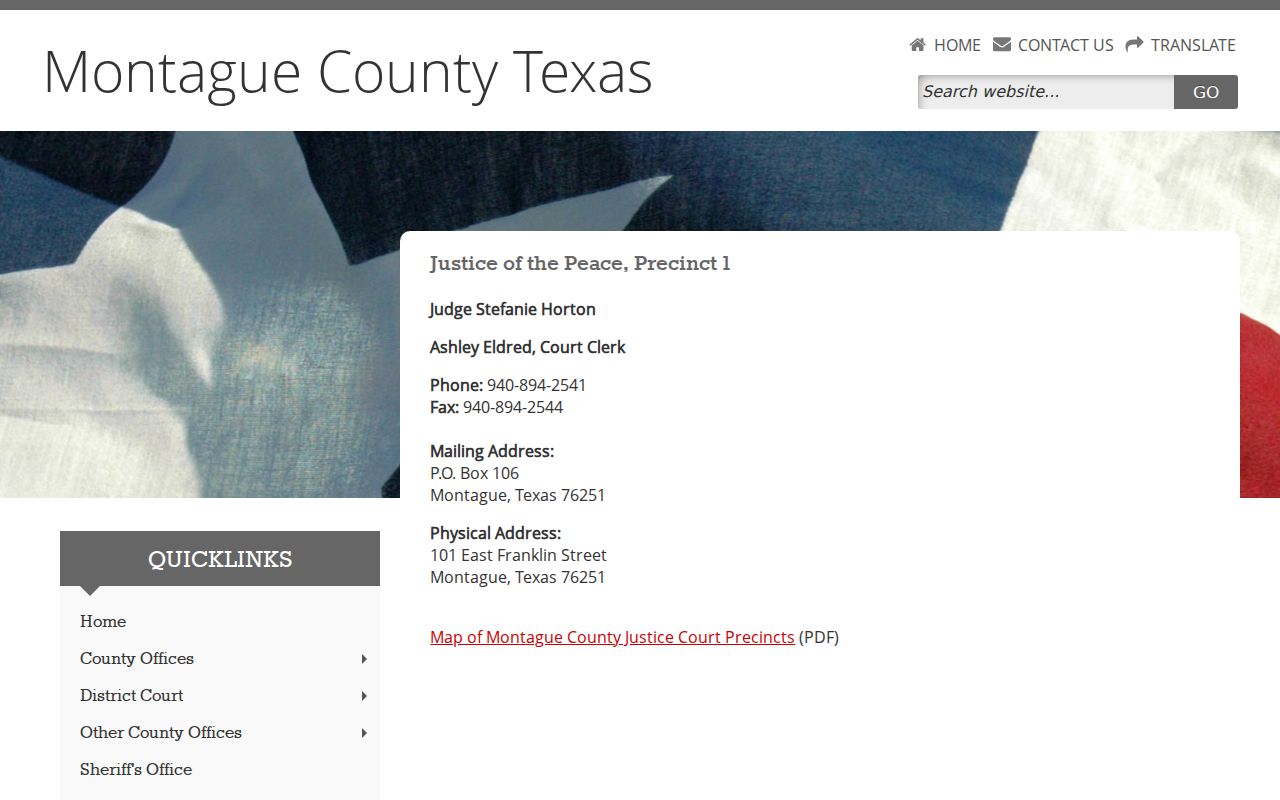
That lower-court channel matters when a fine-only case does not appear among Montague County district or county court results.
Access Rules for Case Records
Montague County judicial case files do not follow the same request path as an executive-agency arrest report. The county's Open Records page explains that judicial records sit outside the Texas Public Information Act. Filed case access instead rests on court rules, court-specific procedures, and constitutional and common-law principles. Send the request to the clerk that maintains the case, not to a central county records officer.
Public access has limits. Juvenile records have special confidentiality rules. Sealed and expunged files do not become public because a name was entered in a portal. Protected victim facts and sensitive identifiers may be redacted, and an unexecuted sealed warrant may not appear. An order of nondisclosure can limit public dissemination without destroying every government record. A missing online result may reflect one of those rules, but it may also reflect an old paper file or the wrong court search.
When the status is unclear, give the Montague County clerk the cause number and ask for a named existing document, such as the judgment or dismissal order. A clerk can supply records and explain office procedure, but cannot give legal advice or decide whether a record qualifies for expunction or nondisclosure.
Montague Court Copy Choices
The District Clerk request form offers certified paper, plain paper, and plain electronic copies. Certification costs $5 per document plus $1 per page. Plain paper costs $1 per page. An electronic document of one through ten pages costs $1 per document, while one with eleven or more pages costs $0.10 per page. A document that is not already electronic costs $1 per page to digitize.
Electronic copies may be sent by email or fax. Certified copies go by first-class mail unless the requester includes a prepaid alternative shipping label. Cash, money order, and online credit card are accepted; personal checks are not. Transaction fees can apply, and the stated fees are nonrefundable. Bulk Montague County court work is priced by quote.
| Montague County copy | Published charge | Best use |
|---|---|---|
| Certified paper | $5 certification per document plus $1 per page | When an official certified record is required. |
| Plain paper | $1 per page | For a readable noncertified file copy. |
| Electronic, 1-10 pages | $1 per document | For a short digital file already held electronically. |
| Electronic, 11+ pages | $0.10 per page | For a longer electronic court document. |
A short electronic copy can cost less than the same Montague County record on paper. Still, the document's purpose should control the choice. Order certification only when it is needed, and name the exact filing so the clerk can quote the work.